Instagram Trial Reels Guide: Test Cuts Fast (2026)
Use this November 2026 guide to test Instagram Trial Reels quickly by duplicating your base edit into three distinct openings.
Contents12 sections
- What Are Trial Reels on Instagram?
- Why Does a Trial Reel Test Need More Than One Cut?
- Which Editing Variables Should You Change Between Trial Reel Versions?
- How Do You Cut Several Versions From the Same Footage Quickly?
- How Do You Test Different Hooks in the First Few Seconds?
- How Do Caption Styles and Reframes Change a Reel's Performance?
- Which Footage Works Best for Trial Reel Variants?
- How Can a Small Team Produce Enough Variants Every Week?
- How Do You Read Trial Reel Results and Pick the Winning Cut?
- How Does Cardboard Help You Make Trial Reel Variants Faster?
- Frequently Asked Questions About Instagram Trial Reel Variants
- How Can You Start Making Instagram Trial Reel Variants?
To make Instagram Trial Reels variants, clean up one clip, keep the middle intact, and duplicate it for three different openings. For a podcast clip, try a question, a strong opinion, and the useful takeaway. You can compare openings without rebuilding every edit.
TLDR:
- Instagram Trial Reels let you test cuts with non-followers before sharing with followers.
- Record results at the same elapsed time for each cut; Meta says metrics are available approximately 24 hours after posting.
- Duplicate your clean base edit into 3 variants. Change one editing variable per test.
- Treat each result as a signal, not a verdict, because test audiences can differ.
- Cardboard AI (cardboard.ai) makes variants from your footage, but doesn’t run Instagram tests.
What Are Trial Reels on Instagram?
Instagram Trial Reels let you test a reel with non-followers before sharing it with followers. Meta introduced Instagram Trial Reels on December 10, 2024.
For example, turn a podcast into a short clip and test a 20-second podcast pricing clip before sharing it with followers. Prepare another cut if you want to compare edits.
Why Does a Trial Reel Test Need More Than One Cut?
An Instagram Trial Reels test needs multiple cuts to help you judge editing choices, though audience differences can affect results. One edit gives you no comparison.
If your trial reels aren’t getting views, check the opening and pacing. A slow setup may bury the useful moment.
Plan for 3 variants per idea.
For example, edit a UGC video with captions and cut a 90-second UGC testimonial into versions lasting 15, 30, and 45 seconds. Post each as a separate trial, keeping the opening consistent to compare how much supporting detail the story needs.
Which Editing Variables Should You Change Between Trial Reel Versions?
Change one editing variable per Instagram Trial Reels test; audience differences can still affect results.
| Variable | What to change | Example |
|---|---|---|
| Hook | Opening line | Lead with the result |
| Length | Detail | Remove a secondary explanation |
| Cutting pace | Shot duration | Shorten pauses |
| Captions | Text style | Try word-by-word captions |
| Framing | Crop | Punch in on the speaker |
| On-screen text | Wording | Name the benefit |
| Music | Background track | Try a quieter track |
For a product demo, which you can prep as a talking head video, test three hooks: result, problem, and customer question. Keep everything else identical.
How Do You Cut Several Versions From the Same Footage Quickly?
Build one clean base edit for Instagram Trial Reels, then duplicate it so you only do cleanup once.
- Trim filler words and dead air.
- Keep the middle section unchanged so the core explanation stays intact.
- Duplicate the sequence three times.
- Change only the opening or caption style in each copy.
- Export each version with the same dimensions and quality settings.
For a 40-minute webinar, start with one 30-second clip, similar to making a cut-out podcast clip. Budget roughly 10 minutes per variant after cleanup, allowing more for audio repairs. Name exports by hook so you can match results to files.
How Do You Test Different Hooks in the First Few Seconds?
Test hooks in Instagram Trial Reels by changing the opening of the same interview clip. Search the transcript for a surprising number, strong opinion, or direct question that works without setup.
Aim to land each hook within 3 seconds:
- Move a strong opinion about founders pricing too low from later in the interview to the opening, the same way you’d build a podcast clip.
- Add an on-screen payoff question: “Could your price be costing you sales?”
- Start with 2 seconds of relevant B-roll, such as the founder revising a pricing page, before introducing the speaker.
How Do Caption Styles and Reframes Change a Reel’s Performance?
For Instagram Trial Reels, test caption style and framing after finding a hook that works. Captions affect reading rhythm; framing guides attention. Change one variable at a time.
- Compare word-by-word pop captions with full-sentence captions, and review why every video needs captions before choosing a style.
- Test keyword emphasis against plain text to see which keeps attention.
- Compare a static wide shot with speaker-tracked punch-ins.
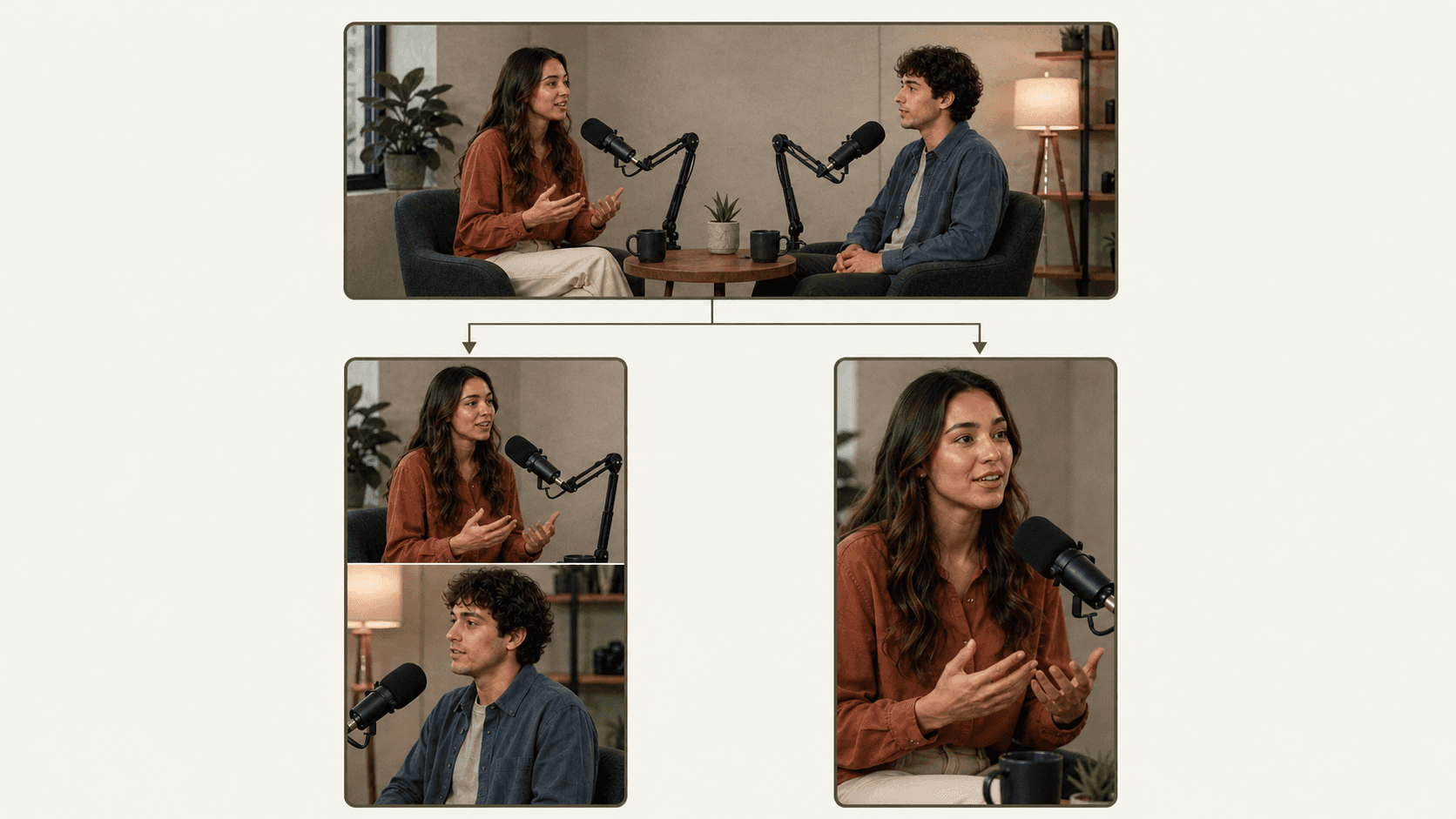
For a two-person podcast, test split-screen against cuts to whoever is talking. Keep captions identical across both versions. Check Instagram’s reel size and aspect ratio guidance before exporting.
Which Footage Works Best for Trial Reel Variants?
Footage with several strong moments works best for Instagram Trial Reels variants.
- Podcasts and interviews: test competing quotes as opening hooks.
- UGC takes: compare lengths or caption styles.
- Product demos: open with the result, then try the problem.
- Event and travel footage: compare a beat-synced montage with a slower story cut.
For a montage, place the music, mark its beats, and cut on the downbeats. Keep the same track in every version, so pacing is the only thing that changes between them.
For example, use an AI reel maker to turn 2 hours of conference footage into a 20-second beat-synced recap and a 30-second speaker-quote version. Post both as Trial Reels to compare creative directions.
How Can a Small Team Produce Enough Variants Every Week?
Batch footage for Instagram Trial Reels so your team can cut variants from one recording session using fixed templates and one review pass.
- Monday: pick 1 to 2 experiments.
- Tuesday: cut variants using saved caption presets and intro and outro templates.
- Wednesday to Thursday: post trials.
- Friday: review results and choose the next edit.
Search your footage library by what was said or shown. One monthly customer interview could supply 4 ideas with 3 variants each, yielding 12 trials. In Cardboard’s video editor in Claude, ask: “Find four ideas in this interview and make three cuts of each with different openings.”
For high-volume clipping of finished long videos, consider a dedicated clipping tool.
How Do You Read Trial Reel Results and Pick the Winning Cut?
Read Instagram Trial Reel results against the variable you changed. Meta lists views, likes, comments, and shares as Trial Reel metrics; for hook or length tests, compare shares relative to views.
Treat one test as a signal, not a final verdict, because audiences can differ. Write a provisional editing rule, such as “open on the number.”
If a result-first hook beats a problem-first opening in a product demo, recut your other product demos with result-first openings. Test those cuts as trial reels before adopting the pattern.
How Does Cardboard Help You Make Trial Reel Variants Faster?
Cardboard helps you make variants for Instagram Trial Reels from existing footage. It doesn’t control Instagram’s testing feature. Describe your edit, and the Director builds a first cut you can adjust on a multi-layer timeline.
For podcast footage, ask: “Make three versions of this with different hooks.” Review each opening and decide which cuts to test.
For a UGC take, ask: “Cut three 15-second edits from this clip, each with a different opening line.” Each version lands on a timeline you can still trim by hand, so you can fix a caption or swap a hook before exporting.
Frequently Asked Questions About Instagram Trial Reel Variants
What are Instagram Trial Reels and how do they work?
Instagram Trial Reels show your reel to non-followers first, but some followers may still see it through shares or other surfaces. Meta explains these visibility limits. For a podcast clip, compare a question-led opening with a strong opinion while keeping the middle unchanged.
How many variants should you make for an Instagram Trial Reels test?
For an Instagram Trial Reels test, plan for three variants per idea. For a product demo, try result-first, problem-first, and customer-question openings while keeping everything else the same.
What’s the fastest way to cut multiple Instagram Trial Reels from the same footage?
To make Instagram Trial Reels variants quickly, build one clean base edit from your podcast footage. Trim filler words and dead air, then duplicate the edit three times and change only the opening in each copy. You do the cleanup work once.
Trial Reels not getting views. Does that mean the idea is weak?
No, low views across three Trial Reels do not prove the idea is weak, because test audiences can differ between cuts. For a podcast clip, try stating the useful takeaway within 3 seconds, keeping the rest unchanged, before judging your editing choices.
How do I find fresh Trial Reel hooks in Cardboard without rewatching an entire interview?
Find Trial Reel hooks in Cardboard by describing what was said or shown, instead of scrubbing through the full recording. For a customer interview, type: “Find moments where the customer mentions saving time, then make three 20-second clips with different openings.” The Director builds the cuts from there.
How Can You Start Making Instagram Trial Reel Variants?
Start your Instagram Trial Reel variants by writing down the editing decision you want to test. For a podcast clip, compare a question-led opening with a strong opinion while keeping the middle unchanged. Try Cardboard with this request: “Make three versions of this podcast clip with different hooks.”