Outsourcing vs AI Video Editing for Growth Teams October 2026
A October 2026 look at outsourcing video editing versus AI tools, and how growth teams finally clear their content backlog.
 Cardboard Team15 min read
Contents14 sections
- Why Growth Teams Are Drowning in Raw Footage
- What Outsourcing Video Editing Actually Means for a Marketing Team
- The Real Cost of a Video Editing Agency or Freelancer Retainer
- The Bottleneck Nobody Puts in the Budget
- How to Outsource Video Editing
- Types of Videos That Make Sense to Outsource
- Multi-Format Distribution
- Repurposing Long-Form Footage Into Short Clips and Ads
- Captions, Translation, and Localization at Scale
- Real-Time Collaboration vs. Async Feedback Loops
- When Outsourcing Still Makes Sense
- How Cardboard Replaces the Agency Relationship for High-Volume Teams
- Final Thoughts on Building a Video Editing Workflow That Scales
- FAQ
Your team captures the footage. Then it sits. The webinar replay, the customer interview, the product walkthrough, all waiting in a folder while your agency queue fills up and your launch date gets closer. If that sounds familiar, the gap between what you record and what you actually publish is worth looking at more carefully than most retainer contracts do.
TLDR:
- Freelancer retainers run $800-$1,500/month; agency contracts run $2,500-$8,000/month, and revision cycles inflate both numbers past the quoted price
- A 3-day agency turnaround becomes 10 days once two or three async revision rounds are factored in
- Outsourcing works for brand films and low-volume teams; high-volume short-form content breaks the retainer model fast
- Three format variants of one video can cost $900-$1,500 at per-deliverable agency rates, consuming most of a mid-tier retainer budget
- Cardboard starts at $8/month (Lite), with unlimited exports on the $29/month Starter plan, handling multi-format exports, footage search, and real-time review without per-asset fees
Why Growth Teams Are Drowning in Raw Footage
91% of businesses now use video as a marketing tool, but producing video and publishing it are two very different problems. Most growth teams have no shortage of raw material: product walkthroughs, customer interviews, launch recordings, webinar replays, event footage. It piles up fast. The editing pipeline, though, moves at a completely different pace.
The result is a backlog that never quite clears. Consider a typical five-person growth team running a SaaS product: they might capture 10 to 15 hours of footage in a single quarter (onboarding walkthroughs, customer interviews, a webinar or two) and publish fewer than five finished assets from all of it. Teams with real creative ambition end up rationing their own footage, publishing far less than they capture. Agencies and freelancers become the default fix, not because anyone loves the process, but because internal bandwidth simply isn’t there.
What Outsourcing Video Editing Actually Means for a Marketing Team
For a marketing team, outsourcing video editing means one of two things: a freelancer retainer or an agency contract. Both are ongoing relationships built around a predictable monthly volume of edits, not one-off projects.
Freelancer Retainers
Typically $800-$1,500/month, you get a set number of deliverables, usually 8-15 short edits, with 1-2 revision rounds each. Communication runs through Slack or email, and turnaround is generally 2-4 business days per asset. The upside is cost. The downside is that one person handling your volume means delays compound fast.
Agency Contracts
Agency retainers run higher, often $2,500-$8,000/month for boutique shops, with dedicated project managers and faster guaranteed turnarounds. You get more structure, but also more overhead: briefs, approval chains, status calls.
In both cases, you’re paying for someone else’s time and availability. The contract defines capacity, and when your content needs spike, you’re either waiting in queue or negotiating a scope change.
The Real Cost of a Video Editing Agency or Freelancer Retainer
Per-project work tells a similar story. A polished marketing video runs $300 to $1,500+ depending on length and complexity, with agencies typically billing $100 to $250 per hour on top of that.
What the invoice rarely shows: revision cycles eat time that isn’t tracked anywhere. Every round of async feedback adds days. File transfers break. A new editor picks up your account and the style resets. These aren’t edge cases; they’re built into how outsourced editing actually operates. The stated retainer cost is the floor, not the ceiling.
| Freelancer Retainer | Agency Contract | Cardboard | |
|---|---|---|---|
| Monthly cost | $800 to $1,500 | $2,500 to $8,000+ | From $8 |
| Turnaround per asset | 2 to 4 business days | 1 to 3 business days (simple); 4 to 5 weeks (complex) | First cut in seconds |
| Revision rounds included | 1 to 2 per asset | Varies; extras billed | Unlimited iterations |
| Multi-format variants (e.g. 3 formats) | $300 to $500 per variant | $900 to $1,500 per set | Included via Smart Reframe |
| Feedback model | Async (email/Slack) | Async + status calls | Real-time timestamped comments |
| Per-asset fees | Yes | Yes | No; unlimited exports from $29/month (4K from $59/month) |
The Bottleneck Nobody Puts in the Budget: Turnaround Time and Revision Cycles
Standard turnaround for a simple social edit runs 1 to 3 business days with most agencies. Complex productions at larger shops can stretch 4 to 5 weeks. Neither number accounts for the revision cycle, which is consistently the biggest unplanned delay in any outsourced workflow.
Here is how it actually plays out: you receive a first cut, drop notes in an email thread, wait two days for the next version, find the feedback was partially applied, and repeat. Two or three rounds of that and your originally quoted 3-day turnaround becomes 10 days. For a time-sensitive launch or a running ad campaign, that is a missed window.
At volume, async feedback creates version sprawl. Files shared through Google Drive, email attachments, and comment docs quickly become impossible to track. “Final_v3_APPROVED_USE_THIS.mp4” is a running joke until it is a real mistake.
How to Outsource Video Editing: A Workflow That Actually Scales
Getting outsourced editing to run reliably comes down to the system you hand your editor, not the editor themselves. A talented freelancer given a vague brief will still burn revision rounds. An average one given a tight brief will often nail it. It is also part of why more teams are turning to AI video editing tools as an alternative to the retainer model entirely.
Here are the five areas worth locking in before your first project starts.
Define Scope Before Anything Else
Be specific about deliverables: how many edits per month, what formats, what lengths, and which channels. Ambiguity here is what causes scope creep and invoice surprises.
Build a Style Reference Doc
Include specs, font preferences, color palette, pacing examples, and two or three reference videos showing what good looks like. Update it when your style evolves.
Set Up Shared Cloud Storage
A consistent folder structure (Raw Footage / Briefs / First Cuts / Approved) eliminates the “which file?” confusion that kills turnaround time. Use proxy files for large footage drops so editors aren’t waiting on uploads.
Write a Brief Template
Each brief should cover the hook goal, key message, target length, required assets, and any dialogue or moments that must be included. One page maximum.
Set Revision Limits in the Contract
Two rounds is standard. Three becomes a habit. Define what counts as a revision versus a new deliverable before the first project starts.
The brief is the lever. Most revision cycles trace back to a brief that left something open to interpretation, not to an editor who missed the mark.
Types of Videos That Make Sense to Outsource
Not every video type fits the same outsourcing model. The decision comes down to two variables: how long the asset stays relevant, and how many versions you need.
High-Production, Long-Shelf-Life Assets
These are the videos worth agency rates and longer timelines:
- Brand films and company overviews that anchor your identity for 12 to 18 months
- Hero launch videos and promo videos for major product releases
- Case study and customer story videos
- Investor or sales enablement content
Some teams in this category also handle onboarding footage by learning how to make training videos internally instead of outsourcing them.
A polished brand film might serve you for 18 months, making a 4-week turnaround far easier to defend.
High-Volume, Short-Shelf-Life Assets
This is where traditional outsourcing starts to break down:
- Weekly social clips and Reels
- Ad variants for testing
- Testimonial cuts from customer interviews
- Event and webinar recap videos
- YouTube Shorts from long-form recordings, often tied back to a TikTok business account strategy
These need fast iteration. Sending 20 short-form clips to an agency retainer means paying boutique prices for work that needs to move in 24 hours, and waiting 3 days per asset instead.
Outsourcing economics are built around deliberate, linear production. High-volume short-form content is the opposite, and a retainer designed for big-lift projects is the wrong tool for it.
Multi-Format Distribution: The Hidden Editing Problem Agencies Don’t Solve Well
Every hero video you produce should live in at least three formats: 16:9 for YouTube and web embeds, 9:16 for Reels and TikToks, and 1:1 for paid social and email. The subject needs to stay correctly framed in each version, which means a simple crop rarely works even with the best social media video editors. An editor has to manually track motion, reposition the frame, and often rebuild text overlays from scratch.
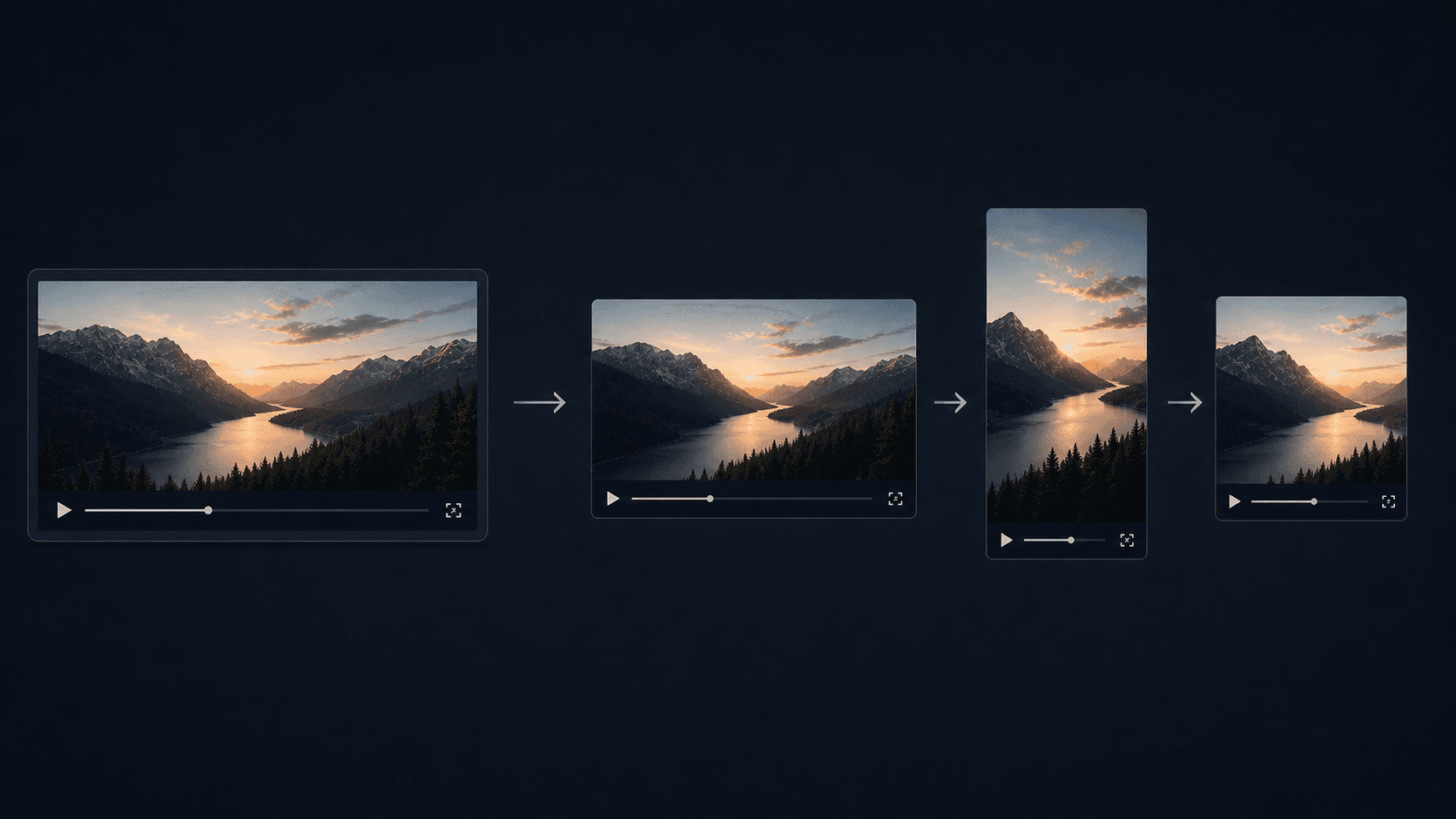
Agencies and freelancers typically charge per deliverable, so three format variants of a single asset can run $900 to $1,500 at standard per-video rates. At two to four hero videos per month, multi-format production alone can consume most of a mid-tier retainer budget before any revisions are factored in.
The compounding problem is that paid social demands constant creative refresh. Ad sets fatigue quickly, and testing a new hook means new variants, a new script included. Teams that need ten ad iterations per week face costs that no standard retainer was designed to absorb.
Traditional outsourcing has never closed this gap well. Agency economics are built around deliberate, one-asset-at-a-time production. Multi-format distribution at speed requires a fundamentally different model.
Repurposing Long-Form Footage Into Short Clips and Ads
One 60-minute customer interview can realistically yield 10 to 15 usable clips: a product moment here, a quotable reaction there, a 20-second testimonial that works as a pre-roll ad. The footage exists. The problem is extraction.
Manual repurposing through a freelancer means someone watches the full recording, logs timestamps, trims each clip, adds captions, and exports per channel. At standard freelance rates, that runs several hours of billable time before you have a single polished asset.
AI has moved into this gap. According to Wyzowl’s 2026 State of Video Marketing report, 63% of video marketers have used AI to create or edit video, up from 51% the previous year. Repurposing is where that shows up most clearly, because the task is repetitive, pattern-driven, and time-consuming in exactly the ways AI handles well.
The repurposing workflow, done right, looks like this:
- Identify quotable or high-value moments via semantic search instead of manual scrubbing
- Trim each clip to platform-appropriate lengths (60s for YouTube, 15 to 30s for Reels and TikToks)
- Add captions formatted for each channel’s viewing behavior
- Reframe to vertical or square as needed
- Export per-channel without re-editing from scratch
What makes this hard at volume through traditional outsourcing is the coordination overhead, not the editing skill. Each clip needs a brief, a revision round, and a file transfer. Multiply that by 15 clips across three formats and you have a project that exceeds most retainer scopes before the first approval.
Captions, Translation, and Localization at Scale
Captions stopped being optional the moment autoplay became the default. Most social video plays without sound until a viewer actively taps in, which means captionless videos lose a viewer before any message lands. Accessibility requirements and algorithmic ranking preferences have made the case even clearer: captioned video consistently outperforms uncaptioned across engagement metrics.
For growth teams distributing across markets, the workload compounds fast. A single hero video in four languages across three aspect ratios is twelve versions, each requiring accurate caption timing, localized text, and correctly formatted overlays per channel. Outsourcing that means billing per language, per format, per revision round.
The manual model also introduces a quality problem. Caption accuracy depends entirely on whoever is transcribing or reviewing the translation, and timing drift between spoken words and caption display is common and rarely caught before delivery.
AI-assisted captioning and translation changes the math. Auto-generated captions, style-locked to brand specs and synced frame-accurately, can go across languages without a full editor cycle per variant. Human review still matters for high-stakes assets, but the first pass no longer needs to be manual, which is why growth teams are adopting Descript alternatives built around this workflow.
Real-Time Collaboration vs. Async Feedback Loops
The async loop is familiar to anyone who has outsourced editing: send a brief, wait two to three days, receive a cut, write up notes in an email thread, wait again. One stakeholder reviews on Tuesday, another on Thursday, and the editor gets conflicting feedback with no clear hierarchy. The resulting revision is a compromise nobody fully approved.
Version sprawl follows. Each round generates a new export, files get renamed across Drive folders and Slack threads, and the question “which cut are we working from?” burns real time on every project. At volume, this overhead is often larger than the editing work itself.
Real-time collaboration, including through the AI video editor for Mac, removes most of this. When reviewers can leave timestamped comments directly on a cut, feedback is specific, accountable, and visible to everyone simultaneously. No synthesis step, no email thread to parse, no ambiguity about which frame the note refers to. Revision cycles that averaged three rounds often collapse to one.
This structural difference matters because async feedback is where outsourcing costs quietly inflate. Revision rounds past two add billable hours and elapsed days that never appear on the original quote.
When Outsourcing Still Makes Sense
Traditional outsourcing earns its price tag in specific situations.
Brand films, investor videos, and major campaign hero spots with complex motion graphics or multi-day color grading are genuinely suited for agency production. The craft required and the lead time to execute properly warrants the overhead. These are assets that anchor positioning for 12 to 18 months, and getting them wrong costs more than the retainer did.
Long-term agency relationships also carry real value when brand consistency depends on a creative director who has internalized your visual language over years. That institutional knowledge is hard to replicate quickly.
Low-volume teams round out the picture. If your team publishes four or fewer videos per month, a stable freelancer retainer at $800 to $1,500 per month covers that output without requiring any process overhaul.
The pattern across all three cases: low frequency, high craft, or high strategic stakes. Outside those conditions, the economics of traditional outsourcing start working against you.
How Cardboard Replaces the Agency Relationship for High-Volume Teams
Cardboard is built for high-volume teams with real footage, real deadlines, and a production pipeline that agency retainers were never designed to handle. Teams from PostHog, Airtable, and Google are already using it.
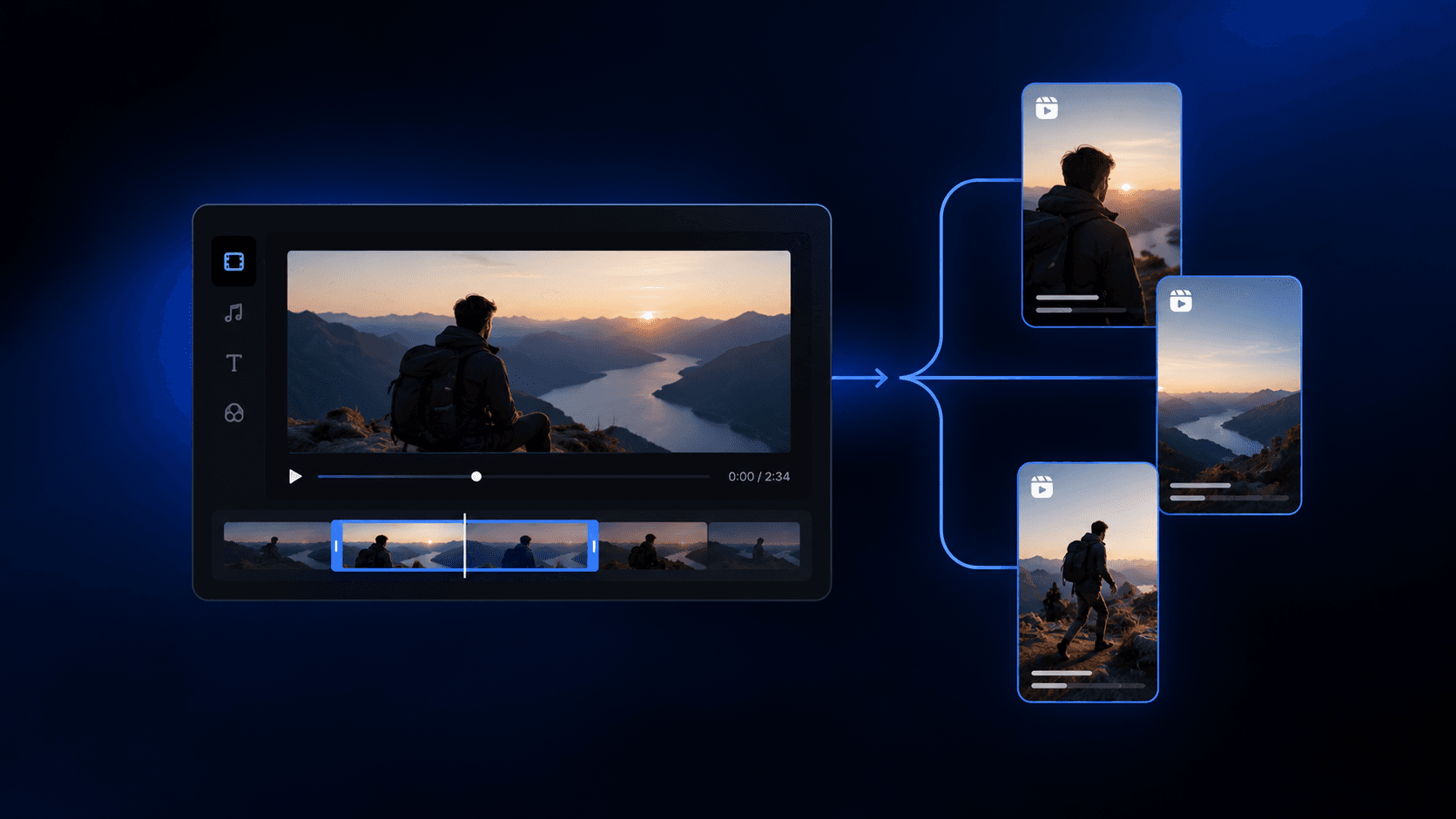
The core mechanic is plain-language editing. Type “cut this into a 20s ad” or “make a 60s recap from this raw footage” and Cardboard proposes a first cut on the timeline in seconds. No brief, no handoff, no 48-hour wait for a draft that misses the tone.
The bottlenecks covered earlier each have a direct answer:
- Multi-format variants handled by Smart Reframe, which turns one widescreen video into vertical and square versions instantly, with no per-format agency fees
- Customer interview repurposing via Semantic Footage Search, finding specific quotes, reactions, and moments across hours of footage without manual scrubbing
- Async feedback replaced by real-time timestamped comments and public shareable links that require no reviewer login
The cost comparison is straightforward. Cardboard’s pricing starts with Lite at $8/month, then Starter at $29/month adds unlimited exports, Creator at $59/month adds 4K exports and larger file support, and Pro at $175/month adds 30x usage and priority processing. Freelancer retainers run $800 to $1,500/month. Boutique agency contracts start around $2,500 and climb past $8,000. For teams publishing at volume, that gap funds a substantial amount of content.
Final Thoughts on Building a Video Editing Workflow That Scales
The agency or freelancer question is really a volume question. Low frequency, high craft work belongs with specialists who can give it the time it needs. But if your team is sitting on footage that never gets published because the pipeline can’t keep up, a retainer was never going to fix that. Cardboard handles the high-volume side of that equation without the per-asset fees or the revision queue.
FAQ
Should I outsource video editing to a freelancer or agency, or use an AI tool like Cardboard for short-form social content?
For weekly social clips, ad variants, and testimonial cuts, AI tools like Cardboard will outperform both freelancer and agency retainers on speed and cost. Freelancer retainers ($800-$1,500/month) and agency contracts ($2,500-$8,000/month) are built around linear, one-asset-at-a-time production, which breaks down fast when you need 15 short clips across three formats in 24 hours. Reserve outsourced video editing services for high-craft, long-shelf-life assets like brand films and investor videos where the production complexity genuinely warrants the overhead.
How do I repurpose a long customer interview into short clips and ads without hiring a freelance video editor for every round?
Use semantic footage search to find quotable moments across the full recording, then trim to platform lengths (15 to 60 seconds), add captions, and reframe to vertical or square, all without a separate brief and revision cycle per clip. Cardboard’s semantic search finds specific quotes, reactions, and scenes across hours of footage so you skip manual scrubbing entirely. A 60-minute interview can realistically yield 10 to 15 usable assets this way, at a fraction of what professional video editing services would charge per deliverable.
How do I reformat a widescreen video into vertical and square versions automatically?
Smart Reframe handles this by tracking the important action in frame and generating correctly composed vertical (9:16) and square (1:1) versions from a single widescreen source, without requiring you to manually reposition the frame or rebuild text overlays. Agencies and freelancers typically charge per deliverable, so three format variants of one asset can run $900-$1,500 at standard per-video rates. Automating multi-format output removes that per-variant billing entirely.
What is the easiest way to add translated captions and AI dubbing to a video at scale?
The fastest path is auto-generated captions synced frame-accurately, then translated across target languages with AI dubbing layered on top, with no full editor cycle per language variant. Cardboard handles caption translation and AI voiceover dubbing in one workflow, with style presets that suppress captions during silences for a polished result. Human review still makes sense for high-stakes assets, but the first pass across every language no longer needs to be manual.
How do I collaborate on video editing with my team without exporting files back and forth?
Real-time collaboration with timestamped comments lets every reviewer leave notes directly on the cut, visible to the whole team simultaneously, so there is no email thread to parse and no ambiguity about which frame a note refers to. Cardboard projects can be shared via a public link with no login required: viewers see the latest published cut, leave timestamped comments without an account, and comment owners can resolve or delete pinned feedback for triage. Revision cycles that typically ran three or four async rounds tend to collapse to one when feedback is specific and accountable from the start.